StudyROM planning guide
Canada to Romania Medical School Roadmap
A Canada-focused roadmap for studying Medicine in Romania, including university comparison, tuition, documents, deadlines, visa timing, MCC checks, IMG risk, and parent due diligence.
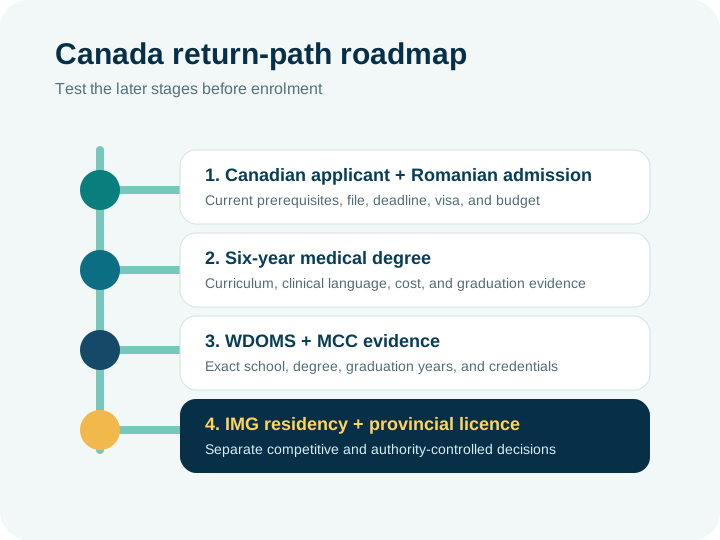
A Canadian can apply to an English-taught Medicine programme in Romania from high school or after university, depending on the university's current eligibility rules. The route can shorten the path to starting medical education, but it creates a major return-to-Canada risk: graduation abroad does not guarantee an IMG residency position or provincial licensure. Compare the exact Romanian programme, model six years of tuition and living costs, build each application file separately, and inspect the school's WDOMS entry, Canada Sponsor Note where applicable, MCC requirements, CaRMS eligibility, and provincial rules before paying.
Published and reviewed June 20, 2026 · About 12 minutes
StudyROM is an independent, source-linked planning platform. It organizes public university, government, directory, examination, and regulator evidence so students can compare decisions without turning one source into a promise it cannot support.
Decision snapshot
Key facts
| Entry routes | High school, university, or graduate background depending on the university |
|---|---|
| Degree length | Commonly six years; verify the exact programme |
| Central return risk | IMG residency selection in Canada is competitive and not guaranteed |
| School evidence | Exact WDOMS entry and Canada Sponsor Note where applicable |
| Parent checkpoint | Full-degree cost and a funded backup plan |
Who this guide is for
Use this roadmap if you expect Canada to remain a possible practice destination and need the Romanian application decision tied to MCC, IMG residency, and provincial due diligence.
Who this guide is not for
This roadmap does not predict CaRMS results, assess an individual's provincial eligibility, or say that studying abroad is equivalent to admission at a Canadian medical school.
Canadian high school and university routes
Some Romanian universities assess applicants after secondary school; others may value or require specific subjects, grades, tests, interviews, language proof, or documents. Prior Canadian university study can strengthen preparation but does not create one national Romanian admission rule. Check each university and intake separately. Do not assume that a Canadian pre-med sequence, MCAT result, or bachelor's degree is required unless the university says so.
The more important question is not simply whether you can start. It is whether your academic preparation, finances, language plan, and intended licensing route make the full six-year programme defensible.
Parent cost and risk review
Parents should request a written full-degree model: current tuition source and academic year; a scenario for annual fee increases; Canadian-dollar exchange-rate stress; housing and deposits; food and transport; insurance; flights; clinical supplies; immigration costs; licensing exams and applications; and an emergency reserve. Identify which expenses are refundable and which are not.
Also document the non-financial risk. A student can complete a legitimate medical degree yet still face uncertainty in Canadian residency selection. The decision should survive that possibility. Use the family budget stress test and save the assumptions that drive the result.
MCC, WDOMS, IMG residency, and provincial licensing
Start with the exact school, degree, and graduation-year evidence. WDOMS describes institutions and Sponsor Notes; the MCC publishes acceptable medical-school and degree requirements. Neither source promises residency. Next inspect current credential verification, examinations where applicable, CaRMS applicant and provincial criteria, return-of-service or citizenship conditions where relevant, and the medical regulator in the province where registration may be sought.
The route is sequential: school evidence, credentials, assessments, residency eligibility, residency selection, training, certification, and provincial registration. A positive answer at one stage does not decide the next.
A practical Canadian scorecard
| Decision | Green evidence | Stop and verify |
|---|---|---|
| Programme | Current university page matches degree, language, and intake | Only agent copy or an old PDF is available |
| Cost | Six-year model survives tuition and CAD/EUR stress | Plan depends on one fixed fee or perfect exchange rate |
| Canada evidence | Exact school and graduation years checked in current official sources | Claim says merely recognized in Canada |
| Residency | Current IMG eligibility and backup destinations documented | Plan assumes a Canadian match |
Ordered roadmap
Use this decision sequence
- 1
Set the Canadian objective
Record whether the intended outcome is Canadian residency, another destination, or a multi-country plan.
- 2
Confirm Romanian eligibility
Check the university's current academic prerequisites, file assessment, language evidence, documents, and deadline.
- 3
Compare school evidence
Match the exact institution and programme to official university sources and the current WDOMS record.
- 4
Build a six-year family budget
Include tuition changes, exchange rates, rent, travel to Canada, insurance, exams, applications, and contingency.
- 5
Create the application calendar
Work backwards from Romanian deadlines, document preparation, visa timing, and enrolment requirements.
- 6
Map the Canadian IMG sequence
Review MCC source verification and examination services, CaRMS rules, provincial eligibility, residency, and final registration.
- 7
Fund a backup route
Define what happens if costs rise, immigration is delayed, or a Canadian residency route is unavailable.
Affordability check
Model the complete cost before a payment decision
Replace general estimates with the exact tuition, city, travel, insurance, application, examination, and contingency assumptions for your route.
Destination checks
Separate the Romania decision from the return pathway
Canada
Medicine applicants should match the exact school, degree title, graduation years, WDOMS entry, and Canada Sponsor Note where applicable, then investigate MCC services, IMG residency eligibility, and the relevant provincial regulator. Dentistry applicants should start with the current NDEB route and provincial registration rules.
Canada Medicine checks Canada Dentistry checksUnited States
Medicine applicants should inspect the exact WDOMS entry and ECFMG Sponsor Note before planning certification, USMLE, residency, and state licensing. Dentistry applicants should investigate CODA-accredited advanced-standing education and the rules of the intended state.
U.S. Medicine checks U.S. Dentistry checksEurope and the United Kingdom
Use the European professional-qualification framework only as a starting point. Check the exact degree title, any required conformity evidence, the destination competent authority, language rules, registration, and the rules that apply when you graduate. The UK has its own regulator-led routes.
Find the destination authorityOther destinations
Start with the national medical or dental regulator, not a recruitment claim. Identify the applicant category, degree assessment, primary-source verification, examinations, supervised training, language evidence, and final registration sequence.
Build a recognition checkEvidence discipline
What each source can and cannot prove
| Claim | Controlling source | It can support | It cannot guarantee |
|---|---|---|---|
| Tuition or programme | Current university page or fee schedule | The listed fee or programme for the stated academic year | Future tuition, total cost, admission, or recognition |
| Application deadline | Current university admission calendar | The published date for the stated intake and applicant group | File acceptance, visa approval, or enrolment |
| Canada - Medicine | MCC and WDOMS | School-level and degree evidence under the current wording | Residency selection, provincial registration, or licensure |
| United States - Medicine | ECFMG Sponsor Notes and WDOMS | Current school and graduation-year eligibility evidence | USMLE success, residency match, or state licensure |
| Canada - Dentistry | NDEB | The current route for graduates of non-accredited programmes | Certification, provincial registration, or employment |
| Europe | European Commission and destination competent authority | The recognition framework and destination process | Automatic employment, language acceptance, or registration |
Common mistakes
- Assuming admission after high school means the Canadian return route is simple
- Reading WDOMS without inspecting the exact school record and Sponsor Note
- Treating MCC document acceptance as a residency guarantee
- Ignoring CaRMS and province-specific IMG criteria until graduation
- Budgeting in euros without stress-testing Canadian-dollar movement
- Having no funded professional or geographic backup
Related tools
Continue with one primary tool
Plain-language answers
Frequently asked questions
Can a Canadian apply after high school?
Some Romanian Medicine programmes consider secondary-school applicants. Confirm the required Canadian subjects, grades, documents, and assessment method for each university.
Do I need the MCAT?
Do not assume a national rule. Check the current Romanian university instructions; the Canadian return pathway has separate requirements.
How long is medical school in Romania?
English-taught Medicine programmes are commonly six years, but verify the exact curriculum and degree with the university.
Does WDOMS listing guarantee Canada eligibility?
No. Check the exact school and Sponsor Note, MCC requirements, graduation years, and every later residency and licensing stage.
Can I return to Canada for residency?
International medical graduates may seek Canadian residency only if they meet current eligibility rules. Selection is competitive and never guaranteed.
What should parents budget?
Model six years of tuition, living costs, travel, insurance, currency movement, exams, applications, and a contingency plus backup plan.
Do Canadians need a Romanian study visa?
Canadian citizens should check the current non-EU long-stay study visa and residence instructions with the responsible Romanian authorities.
What is the safest first step?
Compare exact programmes, check school-level Canadian evidence, and stress-test the entire cost before paying.
Sources and updates
Source provenance
| Source group | How it is used | Review signal |
|---|---|---|
| StudyROM source registry | University programmes, fees, deadlines, and official pathway starting points | 36 references reviewed June 18, 2026 |
| University sources | Exact programme, academic-year fee, admission, and deadline evidence | Recheck before every payment |
| Destination authorities | School, qualification, examination, training, registration, and licensing rules | Recheck before enrolment and application |
| Editorial review | Scope, wording, links, evidence boundaries, and internal navigation | June 20, 2026 |
See the methodology, editorial policy, and corrections process. A later official source controls if it differs from this page.
One decision, one answer
Ask a focused question about your route
Include the programme, university, citizenship, intended destination, and the specific decision you need to verify. Do not send passwords, banking details, or sensitive records.
Ask one focused question