StudyROM planning guide
EU/EEA Student Guide to Medicine and Dentistry in Romania
A Europe-focused guide for EU/EEA students comparing Medicine and Dentistry in Romania, including tuition, admission, clinical language, professional recognition, and registration checks.
EU/EEA students can compare English-taught Medicine and Dentistry programmes in Romania, but EU membership does not make every programme, fee, admission route, or later registration automatic. Verify the exact university and qualification, applicant category, tuition, documents, deadline, and clinical-language expectations. Before paying, identify the competent authority in the country where you may practise and confirm how the professional-qualification framework, qualification title, conformity documents, language evidence, registration, and any local requirements apply. The safest next action is to compare programmes and test the destination process in parallel.
Published and reviewed June 20, 2026 · About 12 minutes
StudyROM is an independent, source-linked planning platform. It organizes public university, government, directory, examination, and regulator evidence so students can compare decisions without turning one source into a promise it cannot support.
Decision snapshot
Key facts
| Applicants | EU/EEA citizens and European destination planners |
|---|---|
| Programmes | Medicine and Dentistry are assessed separately |
| Mobility | Applicant category affects admission and residence steps |
| Clinical issue | Romanian patient communication may be required |
| Recognition boundary | Framework eligibility is not the same as completed registration |
Who this guide is for
Use this guide if you are an EU/EEA applicant or plan to seek professional recognition in an EU/EEA country after a Romanian medical or dental degree.
Who this guide is not for
This is not a statement that a Romanian qualification is accepted everywhere or that language, documentation, professional registration, or employment conditions disappear.
The EU framework without the recognized-everywhere claim
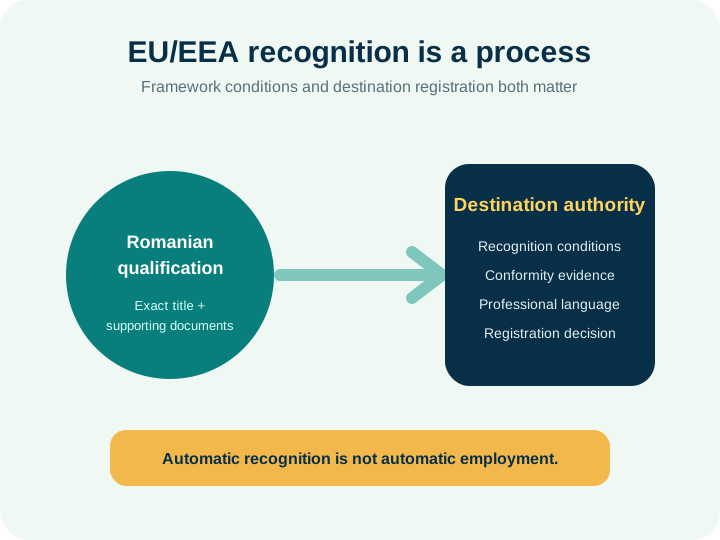
Doctors and dentists are among professions covered by European professional-qualification rules, and automatic recognition may apply when the qualification and every legal condition match the framework. That phrase does not mean automatic employment or registration. The destination competent authority still checks the application, qualification title, documents, language and other lawful requirements. The applicant must use the rules in force when applying.
Confirm the exact Romanian qualification and whether any certificate of conformity or acquired-rights evidence is required. Then use the destination regulator's current application route rather than relying on a broad statement that an EU degree is recognized.
Medicine and Dentistry require separate checks
Medicine and Dentistry have different qualification titles, curricula, professional authorities, and registration files. A medical route cannot prove a dental route. Within the same university, tuition, admission, clinical training, equipment, and source pages can also differ. Compare each programme as its own record.
For Dentistry, ask about equipment, consumables, patient access, practical assessment, and the destination dental regulator. For Medicine, ask about clerkships, internship or practical-training evidence, patient communication, and the destination medical regulator.
Clinical language is a safety and training issue
An English-taught curriculum does not mean every patient interaction occurs in English. Ask the university how Romanian is taught, when proficiency is assessed, and what level is expected before clinical placements. Separately, the destination country may require evidence of its professional language before registration or employment.
Destination-authority comparison
| Check | Romania source | Destination source |
|---|---|---|
| Programme and degree | University programme and graduation documents | Competent authority's accepted qualification wording |
| Admission and tuition | Current university intake pages | Not decided by destination recognition rules |
| Clinical language | University curriculum and placement instructions | Professional language or employer requirements |
| Registration | Degree and supporting certificates | Authority application, fees, evidence, and final decision |
Ordered roadmap
Use this decision sequence
- 1
Choose Medicine or Dentistry
Keep the profession, exact degree title, and likely destination countries explicit.
- 2
Confirm the applicant category
Check the university's current EU/EEA admission track, tuition, documents, language evidence, and deadline.
- 3
Compare exact programmes
Use official programme and fee pages; do not combine evidence from different academic years.
- 4
Plan clinical language
Ask how Romanian is taught, assessed, and used in clinical placements with patients.
- 5
Identify the competent authority
Use the EU regulated-professions resources and the destination's official regulator.
- 6
Test recognition conditions
Check qualification title, conformity evidence, language, registration, fees, good standing, and other destination requirements.
- 7
Recheck before graduation
Recognition and registration rules may change during a six-year degree.
Affordability check
Model the complete cost before a payment decision
Replace general estimates with the exact tuition, city, travel, insurance, application, examination, and contingency assumptions for your route.
Destination checks
Separate the Romania decision from the return pathway
Canada
Medicine applicants should match the exact school, degree title, graduation years, WDOMS entry, and Canada Sponsor Note where applicable, then investigate MCC services, IMG residency eligibility, and the relevant provincial regulator. Dentistry applicants should start with the current NDEB route and provincial registration rules.
Canada Medicine checks Canada Dentistry checksUnited States
Medicine applicants should inspect the exact WDOMS entry and ECFMG Sponsor Note before planning certification, USMLE, residency, and state licensing. Dentistry applicants should investigate CODA-accredited advanced-standing education and the rules of the intended state.
U.S. Medicine checks U.S. Dentistry checksEurope and the United Kingdom
Use the European professional-qualification framework only as a starting point. Check the exact degree title, any required conformity evidence, the destination competent authority, language rules, registration, and the rules that apply when you graduate. The UK has its own regulator-led routes.
Find the destination authorityOther destinations
Start with the national medical or dental regulator, not a recruitment claim. Identify the applicant category, degree assessment, primary-source verification, examinations, supervised training, language evidence, and final registration sequence.
Build a recognition checkEvidence discipline
What each source can and cannot prove
| Claim | Controlling source | It can support | It cannot guarantee |
|---|---|---|---|
| Tuition or programme | Current university page or fee schedule | The listed fee or programme for the stated academic year | Future tuition, total cost, admission, or recognition |
| Application deadline | Current university admission calendar | The published date for the stated intake and applicant group | File acceptance, visa approval, or enrolment |
| Canada - Medicine | MCC and WDOMS | School-level and degree evidence under the current wording | Residency selection, provincial registration, or licensure |
| United States - Medicine | ECFMG Sponsor Notes and WDOMS | Current school and graduation-year eligibility evidence | USMLE success, residency match, or state licensure |
| Canada - Dentistry | NDEB | The current route for graduates of non-accredited programmes | Certification, provincial registration, or employment |
| Europe | European Commission and destination competent authority | The recognition framework and destination process | Automatic employment, language acceptance, or registration |
Common mistakes
- Saying EU degree recognized everywhere without identifying the profession and authority
- Combining Medicine and Dentistry into one recognition answer
- Assuming English teaching removes Romanian clinical-language needs
- Ignoring a destination's professional-language requirement
- Using admission status as evidence of future professional registration
- Failing to recheck the framework and authority process before graduation
Related tools
Continue with one primary tool
Plain-language answers
Frequently asked questions
Can EU/EEA students apply to English-taught programmes?
Yes, where a university offers the programme and the applicant meets its current EU/EEA admission rules. Check the exact intake.
Are fees the same for all EU and non-EU students?
Not necessarily. Applicant category and university policy can affect tuition and admission, so use the current official fee schedule.
Is a Romanian medical degree automatically recognized in the EU?
Automatic-recognition rules may apply when all legal conditions are met, but the destination authority still controls the application and registration.
Does the same rule apply to Dentistry?
Dentistry has its own qualification and authority checks. Do not transfer a Medicine answer to a dental degree.
Will I need Romanian during clinical training?
You may need Romanian to communicate safely with patients. Confirm how the university teaches and assesses clinical language.
Can a destination require its own language?
Yes. Professional language, registration, and employer requirements can apply separately from degree recognition.
Do EU/EEA students need a study visa?
They generally follow a different mobility and registration route from non-EU citizens. Verify current Romanian authority instructions for the intended stay.
Where should I verify recognition?
Start with EU official resources, then use the competent medical or dental authority in the exact destination country.
Sources and updates
Source provenance
| Source group | How it is used | Review signal |
|---|---|---|
| StudyROM source registry | University programmes, fees, deadlines, and official pathway starting points | 36 references reviewed June 18, 2026 |
| University sources | Exact programme, academic-year fee, admission, and deadline evidence | Recheck before every payment |
| Destination authorities | School, qualification, examination, training, registration, and licensing rules | Recheck before enrolment and application |
| Editorial review | Scope, wording, links, evidence boundaries, and internal navigation | June 20, 2026 |
See the methodology, editorial policy, and corrections process. A later official source controls if it differs from this page.
One decision, one answer
Ask a focused question about your route
Include the programme, university, citizenship, intended destination, and the specific decision you need to verify. Do not send passwords, banking details, or sensitive records.
Ask one focused question